

I will tell you the part nobody puts on the box: a bristle-free grill brush does not clean a grate the way a stiff wire brush does. It cleans it differently, and for some cooks that difference is exactly what you want. For others it will feel like a step backward. I have spent about a year with the GRILLART Bristle-Free Grill Brush on my Weber kettle and my Z Grills pellet smoker, and I have a pretty clear picture now of what it is good at, what it is not good at, and what I wish someone had told me before I bought it.
The short version: the GRILLART brush is a solid, well-built tool for keeping a warm grate reasonably clean, and it removes the worry about loose wire bristles ending up in your food. It is not a tool that makes a filthy cold grate look new. If you are the kind of cook who scrubs the grate hot, right after the food comes off, this brush will do right by you. If you let the grill sit for three days and then attack a cold crust, you will be disappointed. That is the honest review in two sentences.
The Quick Verdict
A well-built bristle-free brush that removes the wire-bristle worry and handles warm grates well, but it will not deep-clean a neglected cold grate.
Amazon Check Today's Price →What I Liked
- No wire bristles to break off and end up in your food
- Scraper edge digs into stuck-on char
- 18-inch handle keeps your hand well away from the heat
- Double helix head sweeps a warm grate clean in one pass
- Still solid after a year of regular use and outdoor storage
Where It Falls Short
- Won't do much on a cold grate that has been sitting for days
- Less aggressive than a wire brush on heavy, baked-on crust
- Works best only if you build the habit of cleaning warm
- Listed item weight of 0.27 grams does not match the brush you actually hold
Want to stop worrying about wire bristles in your food?
The GRILLART bristle-free brush is the tool I reach for before every cookout now. It scrubs warm grates clean without a single wire bristle to break loose.
Amazon Check Today's Price on Amazon →How I've Used It
I bought the GRILLART brush about a year ago, after reading about people finding loose wire bristles in their food. That story stuck with me. I had used a wire-bristle brush for years without a problem, but once you hear about a bristle working its way into somebody's throat, it is hard to unhear it. I replaced my old brush and have not looked back.
In that year, the GRILLART brush has been used on two very different grills. My Weber Original Kettle 22-inch gets the most use, mostly charcoal cooks on weekends, burgers and chicken and the occasional pork butt. My Z Grills ZPG-450A2 pellet grill gets used for longer smokes, and that is where the cleaning job is different. A pellet grill grate collects a finer, drier crust than a charcoal kettle does, and it needs a different touch.
The first time I used it was a Sunday in late spring, the kind of day when the whole family comes over. I had put a pork butt on the Z Grills at six that morning, and by the time we ate, the grate had a good layer of cooked-on rub and grease. I let the smoker run hot for a few minutes after the meat came off, then went at the grate with the GRILLART brush. The scraper edge knocked the worst of it loose in a couple of passes, and the head swept the rest into the drip tray. It took me maybe two minutes, and the grate was ready for the next cook. That first session set the pattern for every cook since.
The brush also sees time on the Blackstone griddle when Carol does breakfast on the patio. A flat griddle is the easiest cleaning job there is, no bars to work around, and the scraper edge makes short work of cooked-on egg and pancake batter.
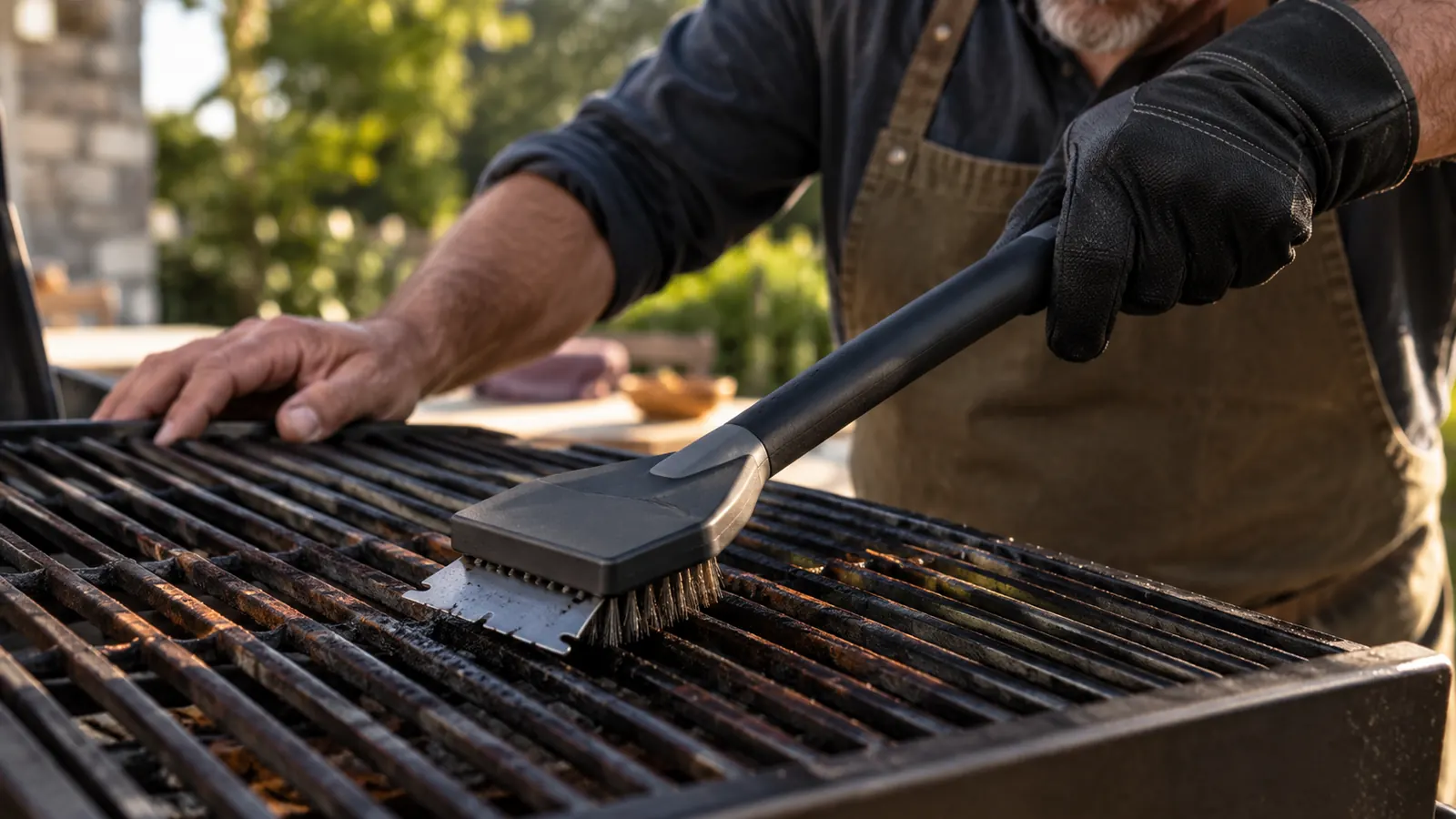
The brush itself is straightforward. It has a stainless steel handle, and the listing says it is 18 inches long, 7 inches wide, and 3.5 inches high. That length matters more than you might think. On a hot kettle, my hand stays well away from the heat, which is the whole point of a long handle. The cleaning head uses a double helix design instead of the more common three-layer helix, and it has a scraper on the edge. That scraper is the part that does the real work on stuck-on bits.
What It Cleans Well
The GRILLART brush is at its best on a warm grate, right after the food comes off. Give it thirty seconds with the grill still hot, and it knocks down the big stuff: charred bits, melted marinade, the crust that a fish fillet leaves behind. The scraper edge handles the stubborn spots, and the bristle-free head sweeps the rest into the coals or the drip tray.
On my pellet grill, I have settled into a routine. After the cook, I crank the Z Grills up a little and let the grate heat for a few minutes, then run the GRILLART brush over it. The residue on a pellet grill is mostly grease and fine ash, and the brush handles it cleanly. I would not say the grate comes out spotless, but it comes out clean enough that the next cook starts fresh. That is all I ask for.
One Saturday in August I put six racks of ribs on the Z Grills for my son's birthday. By the end of that cook the grate looked like a map of everything we had eaten, with a sticky brown residue baked into the bars. I let the smoker run hot for about ten minutes, then worked the scraper edge down each bar one at a time. The residue came off in long strips, and the head swept the rest away. The whole grate took maybe four minutes, and I did not have to worry about a single bristle, because there are none to worry about. That is the kind of clean this brush is built for.
The other thing it cleans well is the thing that matters most to me: it cleans without leaving anything behind. There are no bristles to break off, no wire to shed, nothing to find its way into the next meal. That is the entire reason I bought it, and it has never let me down on that front.
What Nobody Tells You
Here is the part I had to learn the hard way. A bristle-free brush is not a wire brush. It does not have the stiff, aggressive bite that a wire brush has on a cold, crusted grate. If you let your grill sit for a few days and then go at a cold grate with the GRILLART brush, you will be out there a long time, and you will still be looking at crust you cannot move.
I learned this on a Tuesday after a long holiday weekend. The kettle had sat since Sunday night with burger grease and chicken skin dried onto the grate, and I went out that afternoon with the GRILLART brush expecting it to chew through the crust like my old wire brush would have. It did not. The scraper edge skated over the worst of it, the head just polished the surface, and after ten minutes I had a slightly shinier crust and a sore wrist. I tried the scraper harder, then at an angle, then with the head flipped around, and none of it worked. The grate was cold, and that was the whole problem.
The fix is simple, but nobody tells you it on the listing: clean the grate while it is warm. The brush is designed for that job, and it does that job well. The moment I stopped expecting it to behave like a wire brush and started using it the way it wants to be used, my opinion of it went up considerably.
The GRILLART brush is not a wire brush that happens to be bristle-free. It is a different tool for a different job, and the job is warm grates, not cold ones.
The second thing nobody tells you: the scraper edge is the workhorse, and you will use it more than you expect. The bristle-free head is good for sweeping, but the scraper is what digs into the charred spots. On a well-used kettle, I run the scraper along the bars first, then follow with the head to sweep the loosened bits away. It becomes a two-step rhythm, and it works.
One more thing I wish the listing had said: warm does not mean just off the fire, and it does not mean barely warm either. I have had the best results when the grate is still hot enough that you would not hold your bare hand on it, but not so hot that you are fighting your own heat. On the kettle that means right after the food comes off, while the coals are still glowing. On the pellet grill it means a few minutes after the cook ends, before everything cools and sets. Get the timing right and the brush does most of the work for you.
Build Quality and Comfort
The GRILLART brush has held up well for a year of regular use. The stainless steel handle has not rusted, warped, or come loose from the head. I have hung it on a hook on my patio through rain and heat, and it still feels solid in the hand. The listing describes the handle as designed for grip comfort, and I can confirm it is comfortable to hold even when my hands are a little greasy.
The 18-inch length is the right call for a kettle. My hand stays a comfortable distance from the fire, and I can reach the far side of the grate without leaning over the coals. On the pellet grill, the length is almost more than I need, but it does not get in the way.
I will say one thing about the grip. I have fairly big hands from years of turning wrenches, and the handle is not padded, but it does not need to be. The stainless steel stays cool enough to hold even when I have just finished scrubbing a hot grate, and the head is balanced well enough that the brush does not want to tip out of my hand. I have used it one-handed on the far side of the kettle more times than I can count.
One small thing worth noting: the brush is light. The listing lists the item weight as 0.27 grams, which has to be a typo for the whole brush, because the one I hold has some heft to it. I mention it only because if you look at the specs, you will wonder. The handle is stainless steel, so it is not a featherweight, but it is also not tiring to use for a full cleaning pass.

How It Compares to a Wire Brush
I do not want to bury the lede here. A good wire brush with stiff brass or stainless bristles will remove crust from a cold grate faster than the GRILLART brush will. That is just physics. The bristles are aggressive in a way that a flat scraping surface is not. If your only goal is maximum scrubbing power on a neglected grate, a wire brush wins.
But the wire brush has a weakness that is hard to ignore once you know about it: bristles come loose. They break off, they stick to the grate, and sometimes they end up in the food. It does not happen every time, and it may never happen to you. But the consequence is bad enough that I decided the trade was worth making.
The wire brush I used before the GRILLART was a cheap one from the hardware store, the kind with a wooden handle and stiff bristles set in a metal band. It scrubbed hard, and I never found a bristle in my food in all the years I used it. But I also never checked for one, because it did not occur to me to check. The story that made me switch was about a man who found a bristle stuck in his gums after a cookout, and the more I thought about it, the more I realized I had no way to know my brush was not shedding. A bristle is thin and silver and easy to miss on a dark grate. That uncertainty is what I gave up, and I do not miss it.
What I tell people is this: the GRILLART brush trades a little raw scrubbing power for peace of mind, and it makes up for some of that power by being used at the right time. Clean warm, and you do not need the aggression of a wire brush. Clean cold, and you will wish you had one.
Who This Is For
This brush is for the backyard cook who cleans the grate while the grill is still warm, which is honestly the right habit anyway. It is for the person who has read the stories about wire bristles and wants that worry gone. It is for the cook who wants one less thing to think about at a cookout, and who would rather spend thirty seconds on a warm grate than fifteen minutes on a cold one.
It is also for anyone who cooks on a pellet grill or a gas grill where the residue is mostly grease and ash. The GRILLART brush handles that kind of cleaning easily, and the bristle-free head is easy to rinse off when you are done.
Who Should Skip It
If you are the kind of cook who lets the grill sit for a week and then expects one pass with a brush to make the grate look new, this is not the brush for you. You will fight it, and you will be frustrated. You are better off with a wire brush and a good burn-off, or a dedicated grate cleaner.
I would also say this: if you are a competition cook or someone who needs a truly spotless grate every single time, the GRILLART brush may not be aggressive enough for your standards. It gets the grate clean enough to cook on, and it does it without bristles, but it is not a heavy-duty restoration tool.
Ready to make the switch before your next cookout?
A year in, the GRILLART bristle-free brush is still hanging on my patio and still doing the job every weekend. If you clean warm and want the bristle worry gone, this is the one I would buy again.
Amazon Check Today's Price on Amazon →