

I will tell you the part nobody puts in the product photos: the MEATER Plus spends most of its life in a drawer. I have owned mine for about a year and a half, long enough to use it on my Weber kettle, my Z Grills pellet smoker, and even the Blackstone griddle when Carol is not using it for breakfast. And the honest review is not a straight line. It is a thermometer that can make you a better backyard cook, and it is also a thermometer that will frustrate you at exactly the wrong moment if you do not understand what it is. So let me tell you what it actually does, what it does not do, and who should skip it entirely.
The Quick Verdict
A genuinely useful wireless thermometer for low-and-slow cooks who will use the app, with real limits on range and battery that you should know about before you buy.
Amazon Check Today's Price →If you cook low and slow, this is the probe that finally gets you out of the chair
I bought the MEATER Plus after one too many afternoons camped next to the kettle watching a dial. It is not perfect, and I will walk you through every flaw. But for brisket, pork butt and ribs, it changed how I spend a Sunday.
Amazon Check Today's Price on Amazon →How I've Used It
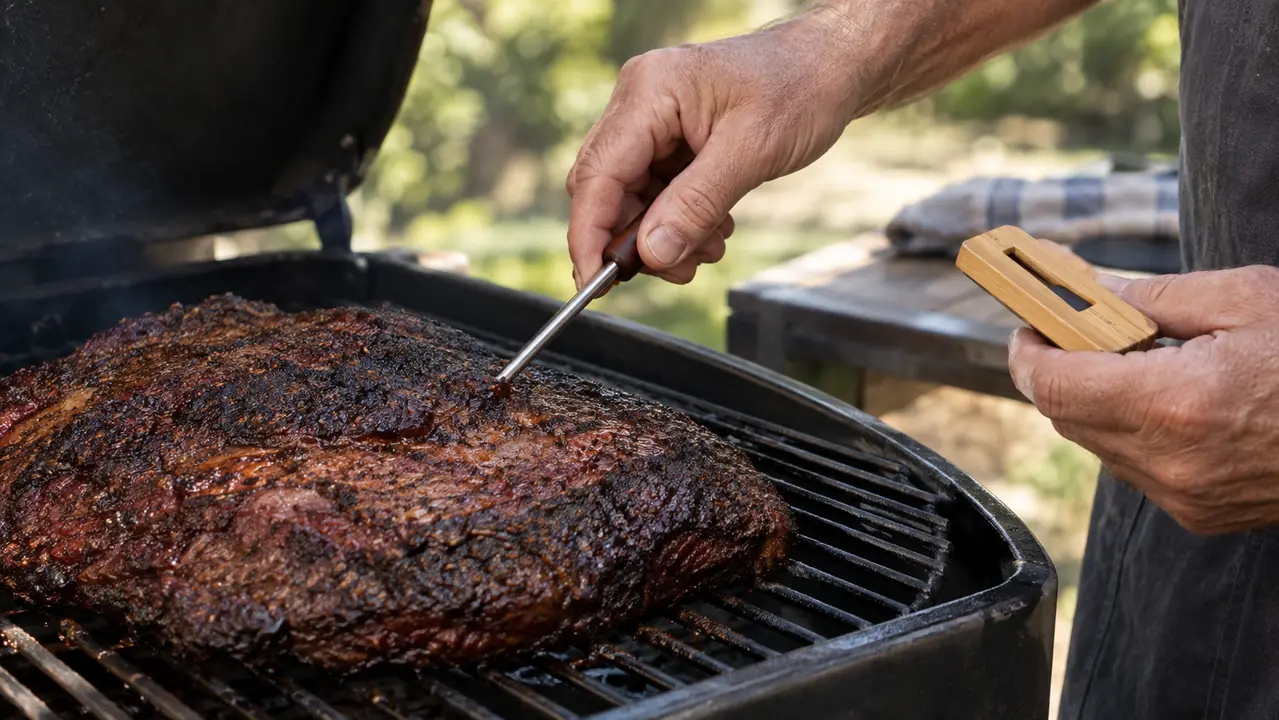
I am a retired HVAC technician, so I tend to judge a tool the way I judged a thermocouple on a furnace: does it read right, does it keep reading, and does it make the job easier? The MEATER Plus is a 100% wire-free probe, which means there is no cord running out of the smoker and no foil-wrapped bundle jammed in the lid gasket. The probe is stainless steel, with a bamboo charger that also holds a spare AAA battery. That is the whole kit: one probe, one bamboo charger, one battery.
The probe has dual sensors, so it reads both the internal meat temperature and the ambient temperature inside the grill. That second reading is the feature I did not expect to care about, and it turned out to be the one I use most. On my Z Grills pellet smoker, the controller already tells me the box temperature, but it reads at the hopper side. The MEATER Plus reads at the meat. On a charcoal kettle, that is the difference between guessing and knowing. The first Sunday I used it, I had a rack of spare ribs on the kettle and the lid thermometer said we were holding 275. The MEATER Plus said the air right at the meat was running closer to 315, which explained why the ribs were already darkening faster than I liked two hours in. I shut the bottom vent a quarter turn, and about forty minutes later the ambient reading settled at 285. That one cook taught me more about how my kettle breathes than the previous five years of lifting the lid to check.
Charging is simple. A five-minute charge gives you about two hours of cook time, and the charger tops it back up when you set the probe in it. The temperature range goes from 32 degrees up to 527 degrees, and the response time is about three seconds. The probe is waterproof, which matters more than you would think, because I have dropped mine in a sink full of soapy water twice.
What Nobody Tells You About the Range
Here is the part the marketing glosses over. The MEATER Plus connects to your phone over Bluetooth with a rated range of 165 feet. That sounds like you could monitor a brisket from the far end of the house. In practice, Bluetooth range depends on what is between the probe and your phone. My patio is at the back of the house, and the signal has to pass through a brick wall, a refrigerator, and a set of kitchen cabinets before it reaches the living room. On a good day, I can sit on the couch and watch the temperature climb. On a bad day, the app drops the connection when I walk from the patio to the kitchen.
One Sunday last fall, I had a brisket going on the pellet grill and went inside to watch the Chiefs game. The connection held through the first quarter, then dropped somewhere in the second and never came back until I walked out to the patio. The meat was fine, but I had spent the whole afternoon wondering whether the smoker had drifted while I was not watching. That is the thing to understand: 165 feet is the rating in open air, and my house is not open air. Your house is not either.
The fix is the charger. The charger has a built-in Bluetooth repeater, so if you keep the probe near the charger and the charger somewhere between the grill and where you sit, the range stretches a lot farther. That is the workaround, and it is a good one, but it is work. You are not just sticking a probe in a brisket and walking away. You are placing the charger like you would place a Wi-Fi extender, and if you skip that step, you will lose the connection at the worst possible time.
The MEATER Plus is not a set-it-and-forget-it tool. It is a set-it-and-think-about-where-you-sit tool, and that is an honest difference.
The App Is the Real Product
I will be straight with you: I am a sixty-one-year-old retired HVAC tech, and I was skeptical of a meat thermometer that needs a phone app. But the app is where the MEATER Plus earns its keep. You set a target temperature for the meat, and it walks you through a cook with a timer and a live graph. You can watch the internal temperature climb in real time, and you can set the ambient alarm so it hollers at you when the grill drifts.
The first time I used it on a pork butt, I set the target at 203 degrees and went inside to slice onions. It was a 9-pound shoulder I had put on the kettle at 6:30 in the morning, and by early afternoon the app showed the internal temp climbing steadily, then stalling around 160. That is the stall every barbecue cook knows, but knowing it and watching it happen on a graph are two different things. On the old setup, I would have stood at the grill, second-guessed the coals, and probably wrapped the meat too early. With the MEATER Plus, I could see that the meat temperature was still climbing, just slowly, maybe a degree every twenty minutes, and the ambient temperature was holding at 275. So I left it alone. It came out at 5:40 that evening, pulled clean, and the grandkids ate it like it was their job. That was the cook that sold me on the app, because it was the first time I had watched a stall instead of panicking through one.
That is the real value of this thermometer. It does not cook the meat for you. It gives you information that lets you leave the meat alone, and leaving it alone is the hardest part of barbecue. The graph is the part I did not expect to like. When you can see the whole arc of a cook, from the cold start in the morning to the final climb past 200, you start to understand what your grill is doing at every stage. You notice that the temperature dips every time you open the lid, and you start opening the lid less. That alone is worth the trouble of learning the app.
The Battery and Charging Reality
The specs say a five-minute charge gives about two hours of cook time. That is roughly true, but let me be precise about what that means for a long cook. A brisket can run twelve hours. A pork butt can run eight. You will need to set the probe back in the charger for a few minutes mid-cook, which drops the meat temperature reading while it charges. If you do that during the stall, you are not missing much. If you do it during the final climb, you are flying blind for five minutes. Last spring I did a 14-pound brisket on the pellet grill and got caught flat-footed anyway. I had topped the probe off during the stall, around 11 in the morning, and figured I had plenty of time. But the final climb came faster than I expected. Around 2 in the afternoon the app warned me the battery was low, with the meat at 178 and climbing into the final stretch, exactly the wrong time to lose the reading. I pulled the probe, set it on the charger for six minutes, and put it back in the same hole. The internal temp had gained maybe two degrees while I was blind, and the cook finished fine. The lesson stuck: schedule the charge during the stall, when nothing is moving anyway, and keep the charger on the prep table where I cannot miss it.
The included AAA battery powers the charger, not the probe. The probe has its own rechargeable cell, and the bamboo charger holds the spare. I have replaced the AAA once in a year and a half, which is cheap and easy. The probe itself has never failed to hold a charge, and the waterproofing has held up through two sink incidents and a rain shower that snuck up on a pork shoulder.
The honest complaint is that two hours is not a full day's cook. For a long brisket, you are going to do the charge dance at least a few times. It is not a dealbreaker, but it is a thing nobody tells you in the reviews that just say 'wireless and easy.'
Where the MEATER Plus Shines
On the Weber kettle, this probe is the difference between a great rack of ribs and a so-so one. The kettle is a charcoal grill, which means the temperature is always drifting. The dual sensors let me watch both the grate temperature and the meat temperature on the same screen, and I can adjust the vents before a drift becomes a disaster. The ambient probe reads at the meat, not at the lid, so it catches hot spots that a lid-mounted gauge simply cannot see.
On the pellet grill, it is less essential because the controller already manages the box temperature, but it is still useful for the meat-side readings. And on the griddle, it is almost overkill, though it is handy for checking thick pork chops when Carol is not using the griddle for pancakes.
The response time of about three seconds matters more than I expected. When you are probing a steak that is close to done, you do not want to wait thirty seconds for the reading to settle. Three seconds is fast enough that you can check, decide, and pull the meat at the right moment.
What Nobody Tells You About the Probe Design
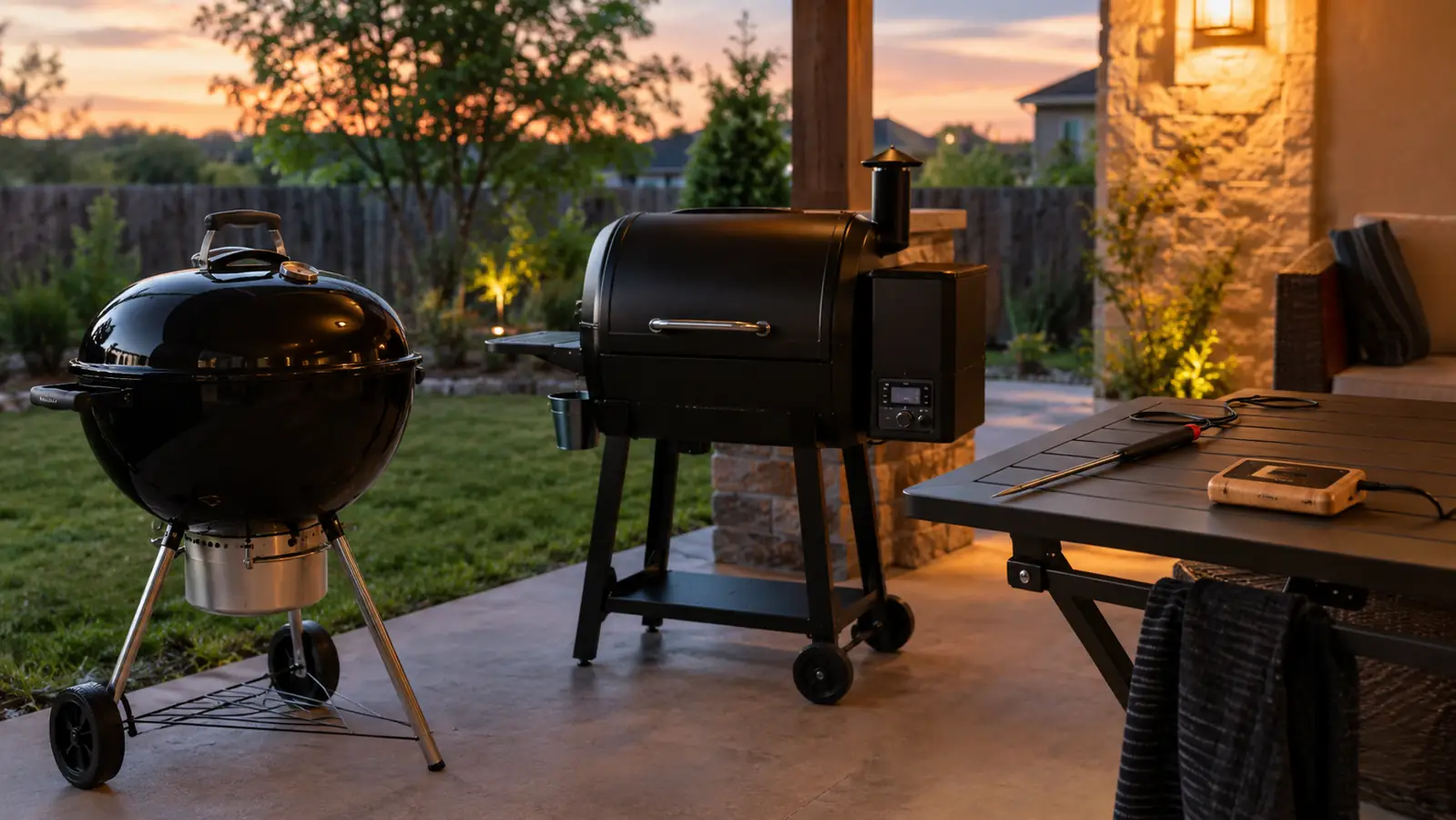
The probe is a single long stainless steel skewer with the sensor in the tip and a second sensor partway up the shaft. To get a good ambient reading, the shaft has to be exposed to the air inside the grill, which means you cannot bury the whole probe in a thick roast. You want the tip in the center of the meat and the upper sensor out in the open. That sounds obvious, but it took me a few cooks to get the placement right, and a bad placement gives you a misleading ambient number. I remember one chicken cook where I shoved the probe in at an angle and the ambient reading showed 350 while the grate was clearly running closer to 275. The chicken cooked fine, but the graph was nonsense, and I spent an hour chasing a temperature problem that was really a probe placement problem. Once I started pushing the probe in straight, along the same line as the muscle fibers, the readings made sense again.
The immersion depth is listed at 6.18 inches, which is plenty for a brisket flat or a pork butt. For a thin steak, the probe is overkill, and you are better off with an instant-read thermometer. The MEATER Plus is a slow-cook tool, not a steak tool, and the sooner you accept that, the happier you will be with it.
The Honest Cons List
What I Liked
- Truly wire-free, so no cords to melt on the lid or snag when you open the grill
- Dual sensors read both meat and ambient temperature, which is the feature I use most
- Five-minute charge gives about two hours of cook time, and the bamboo charger is easy to keep on the prep table
- Waterproof probe has survived two sink drops and a rain shower
- App with timer, target temperature, and live graph is genuinely useful once you learn it
- Fast three-second response time when you want a quick check
Where It Falls Short
- Bluetooth range is realistic, not magical, and brick walls will eat the signal
- Two-hour battery means a charge dance on long brisket cooks
- The app is required for the best experience, and it takes a few cooks to trust it
- Ambient sensor placement takes practice, and bad placement gives you a misleading reading
- Not the right tool for thin steaks or quick grilling, where an instant-read is faster
Who This Is For
The MEATER Plus is for the backyard cook who is done hovering over the grill. If you cook pork butts, brisket, or whole chickens on a charcoal kettle and you are tired of opening the lid every twenty minutes to check on things, this probe will change your Sunday. It is also for the person who wants to learn, because the app shows you what is actually happening inside the cook. You will learn what a stall looks like, what a temperature drift looks like, and what happens when you leave a good cook alone.
It is a good fit if you already own a charcoal grill and you cook low and slow at least a few times a month. It is an even better fit if you are willing to spend one cook learning how to place the probe and where to set the charger.
Who Should Skip It
Skip it if you mostly grill steaks, burgers, and chicken parts that cook in under an hour. For that cooking, a simple instant-read thermometer is faster, cheaper, and does not need a phone. Skip it if you refuse to use a phone app, because the app is the best part of the experience and you are paying for it whether you use it or not. And skip it if you want a thermometer that will run a twelve-hour brisket on a single charge, because this one will not.
I would also tell a friend to skip it if they are the kind of cook who already nails temperature by feel and never writes anything down. The MEATER Plus gives you data, but only if you look at the data. If you will not open the app, you are better off sticking with the method that already works for you.
The Bottom Line
I have owned the MEATER Plus for about a year and a half, and I would buy it again. It is not the perfect thermometer, and the range and battery limits are real. But for the cooking I actually do, which is low and slow on a charcoal kettle and a pellet smoker, it has paid for itself in saved afternoons and better brisket. The MEATER Plus will not make you a pitmaster. It will just make you a calmer one, because you will finally know what is happening inside the grill without standing over it.
The bottom line: buy it for low and slow, skip it for burgers
If you cook brisket, pork butt, or ribs on a charcoal grill, the MEATER Plus is worth a spot on your prep table. If you only grill quick stuff, keep your money. That is the honest answer.
Amazon Check Today's Price on Amazon →