
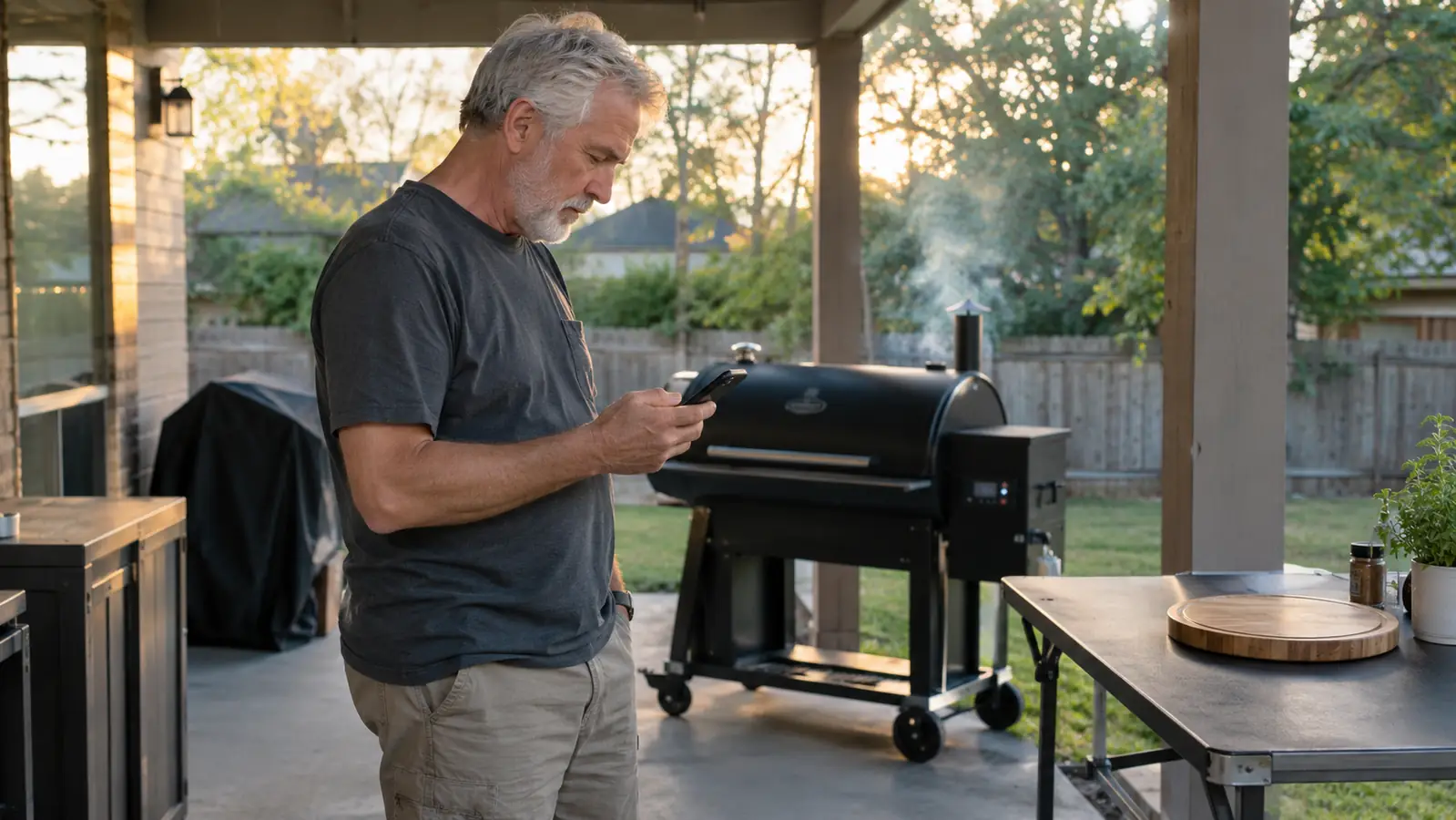
I spent thirty years as an HVAC technician, which means I trust a number I can read over a guess I can feel. For most of my barbecue life, that meant I checked a brisket the old way: poke it, squeeze it, cut into it, lose the juice, and hope I hadn't ruined Sunday dinner. I bought a cheap instant-read thermometer somewhere in there, but it only helped when I remembered to use it, and it meant standing over a hot fire with my arm in the smoke. Then, about a year and a half ago, I bought a MEATER Plus on a Tuesday afternoon and used it that same weekend. It has been on my patio for every cook since, and it changed how I work a fire more than any single tool I've bought since I retired.
The MEATER Plus is a wire-free probe with two temperature sensors and a bamboo charger that doubles as a signal repeater. You charge the probe for five minutes, stick it in the meat, and read the temperature on your phone from as far as 165 feet away. No wire running across the patio. No standing over a hot grill with a handheld thermometer. No guessing. It sounds like a gadget, and I'm not a gadget guy. But a thermometer that lets me sit in the house and watch the game while the brisket cooks is not a gadget. It's a tool. For a backyard cook who spent decades doing it the hard way, that's a bigger deal than it sounds.
The Quick Verdict
The probe I reach for on every cook. Dual sensors, a 165-foot range, and a five-minute charge for two hours of cook time. It has limits on very long cooks, but it has earned its spot on my prep table.
Amazon Check Today's Price →The wire-free probe that stays in the meat, not in my way
After a year and a half of briskets, pork butts, and Sunday chickens, the MEATER Plus is the thermometer I trust on every grill I own. Dual sensors track the meat and the air, and the app does the math so I don't have to.
Amazon Check Today's Price on Amazon →How I've Used It
I cook most weekends, usually for the whole family. The kids show up with the grandkids, and I'm the one standing at the grill. The MEATER Plus has been through every kind of cook I do. On the Weber kettle, I use it for beer-can chicken and thick pork chops. On the Z Grills pellet smoker, it's been in every brisket and pork butt I've made since I bought it. I've even used it on the Blackstone griddle when I'm cooking thick steaks and want to nail the middle instead of guessing. The grandkids are old enough now to want to help, and the MEATER Plus gives me a way to show them what done looks like on a screen instead of telling them to trust my thumb.
The routine is simple. I set the probe on the bamboo charger that sits on my fold-out prep table, give it five minutes, and stick it in the meat before it goes on the fire. The app connects through Bluetooth, and because the charger has a repeater built in, I can wander to the far end of the yard and still get a reading. When I'm inside watching the game, I check the phone instead of opening the lid and letting the heat out. That sounds small, but on a cold November day it's the difference between enjoying the cook and babysitting it.
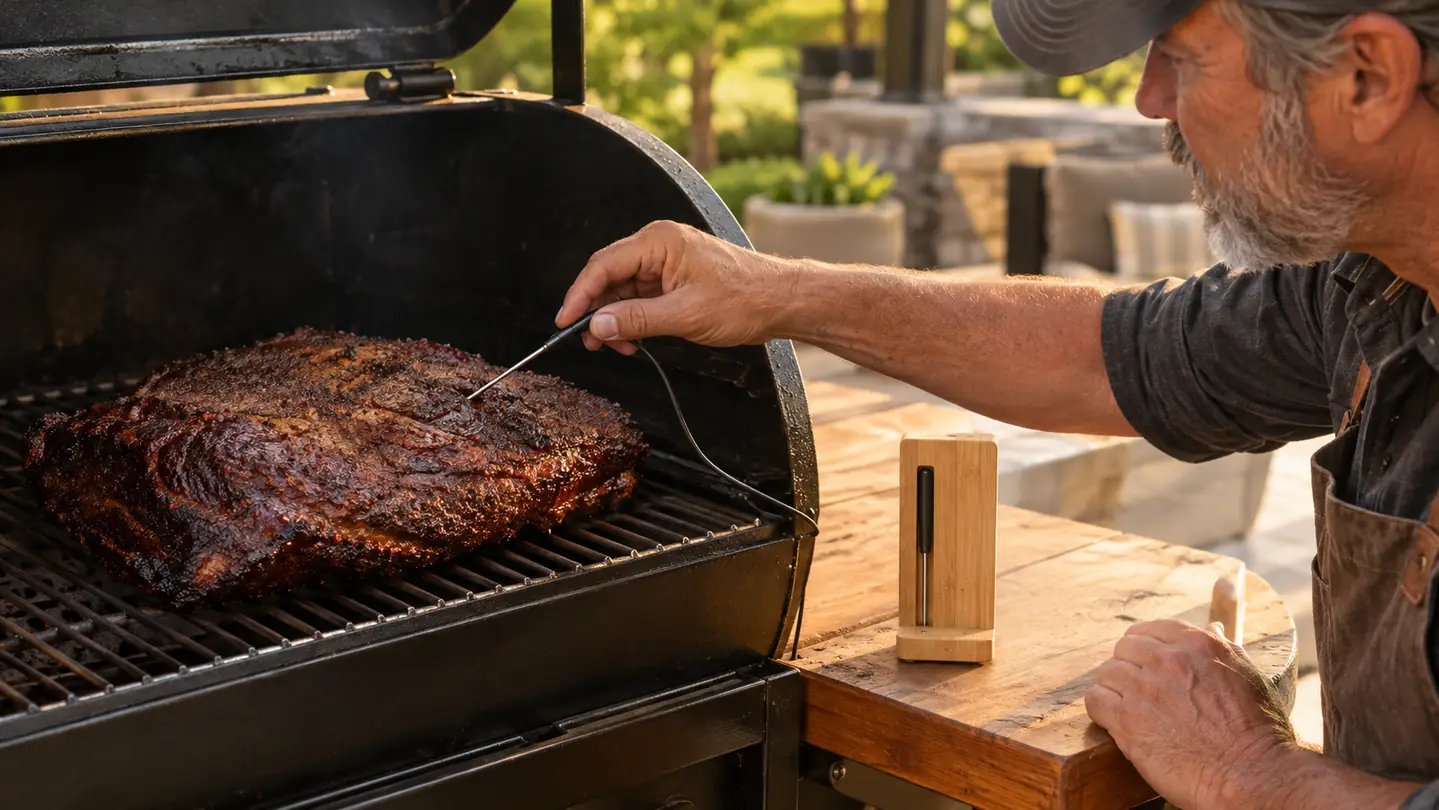
I've used it on short cooks and long ones. A beer-can chicken on the kettle runs maybe an hour and a half. A brisket on the pellet grill can run twelve. The probe handles both, and the dual sensors are the reason. One sensor reads the internal meat temperature, up to 212 degrees, and the other reads the air around it, up to 527 degrees. When the ambient reading tells me the fire is drifting, I can fix it before the meat pays for it. That's the part I didn't expect to love: the probe caught problems I used to find three hours too late.
What the Dual Sensors Actually Do
Most thermometers I've owned over the years gave me one number: the temperature inside the meat. That's useful, but it only tells you half the story. The MEATER Plus reads two things at once. The internal sensor tracks the meat, and the second sensor tracks the temperature of the air inside the grill or smoker. For low-and-slow cooking, that second number is the one that keeps you honest.
On a pellet grill, the controller is supposed to hold a temperature, but I've learned to trust a probe over a dial. If the ambient sensor says the air is running hot, I know the brisket is going to cook faster than the recipe says. If it's running cold, I know I need to give the cook more time. The MEATER Plus responds to a change in about three seconds, so I see the drift early instead of discovering it three hours in. An HVAC guy spends his whole career chasing temperature swings, so this part spoke to me.
The temperature range matters too. The probe reads from 32 degrees all the way up to 527, which covers everything from a cold smoke to a searing hot grill. The stainless steel probe is waterproof, so a rain shower on the patio or a trip through the sink doesn't bother it. And the 6.18-inch length is enough to reach the center of a thick brisket flat without the handle end tilting over.
That extra ambient reading changed how I cook on the kettle too. On a charcoal grill, the fire is always moving. It spikes when you add a chimney of lit coals and settles as they ash over. The ambient sensor shows me that curve, so I know when to add fuel and when to leave it alone. It's the difference between riding the temperature and chasing it.
The Range, the App, and the Charger
The 165-foot range is the spec, and it's the open-air number. In practice, with the charger sitting on my prep table and the house between me and the smoker, Bluetooth gets thin past a couple of walls. The repeater in the charger helps, and the Wi-Fi support helps more when I'm further out. I've been upstairs in the back bedroom and still been able to watch the temperature climb on the phone. That's the whole point of a wireless thermometer: you don't have to sit next to it.
The app is where everything shows up. It gives you the internal temperature, the ambient temperature, and a timer, all on the phone. I'm an old-school guy, and I was ready to hate the phone part. But being able to step inside and check where things stand without opening the lid is worth a lot. I can look at the numbers and know whether to add fuel or leave the fire alone. It's like having a second set of eyes on the cook, and the timer keeps me honest when I'm doing sides in the kitchen and lose track of the main event.
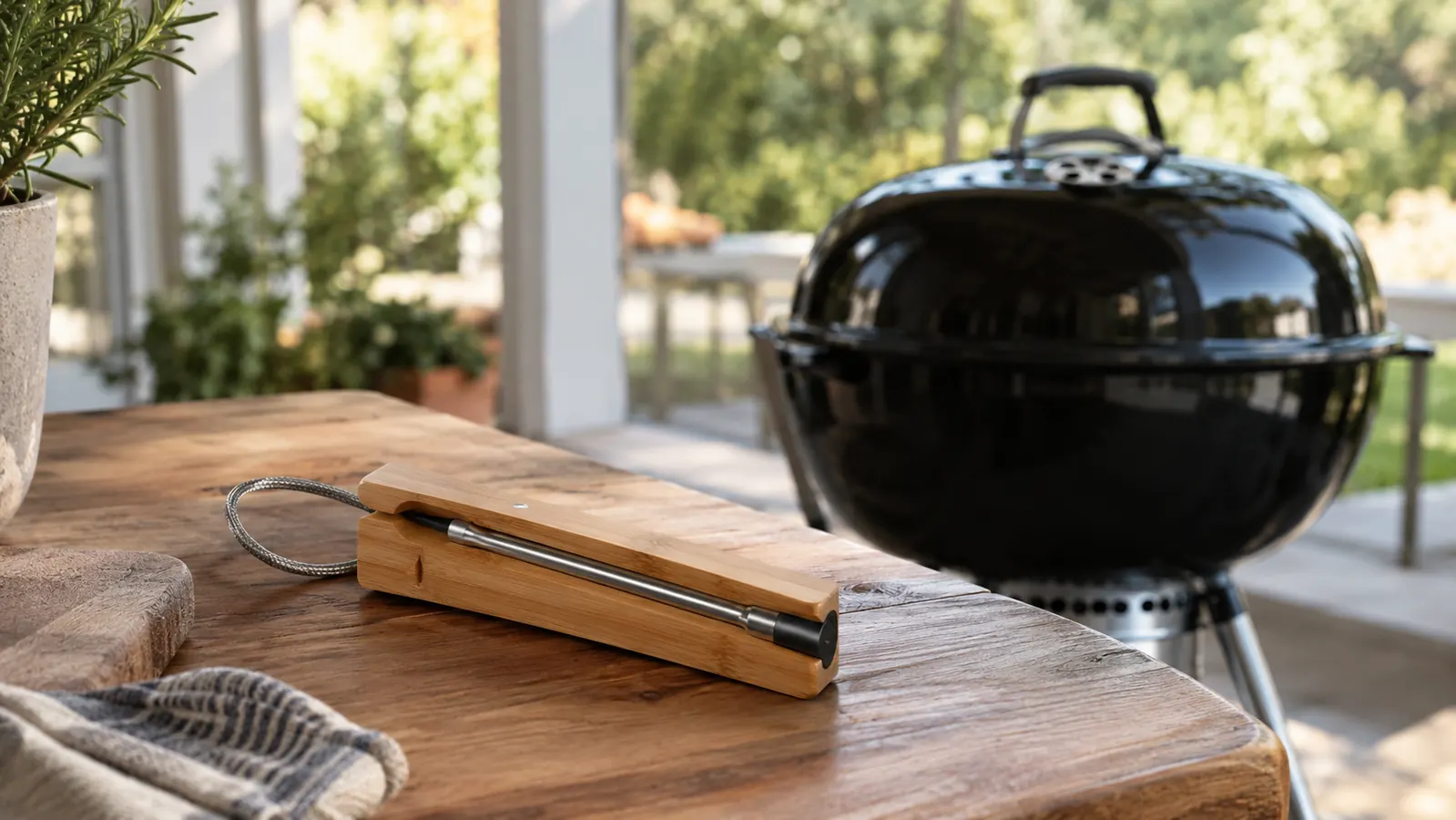
The bamboo charger is the piece I didn't expect to like. It sits on the prep table, holds the probe when it's not in use, and charges it at the same time. The five-minute charge gives about two hours of cook time, which covers most of what I do on a weekend. The charger also works as a Bluetooth repeater, which extends the range across the yard. One AAA battery runs the charger, and it came in the box. I've replaced it once in a year and a half.
One thing I'll tell you from experience: read the thermometer, not the clock. The app shows the internal temperature and the ambient temperature side by side, and the probe responds in about three seconds. When the number starts climbing toward where I want it, I head outside and start checking. The timer keeps me honest when I get pulled inside to help with the sides. It's like having a second set of eyes on the fire.
The Honest Limits
I said I'd be honest, so here's where the MEATER Plus falls short. The two-hour cook time on a five-minute charge is fine for chickens and pork butts. For a big brisket that runs twelve hours, I have to pull the probe out, give it a quick charge, and put it back in. It's a five-minute interruption, and it doesn't ruin the cook, but it's a real thing to plan around. I've learned to time the charge so the probe is topped up before the meat goes on, and for most cooks that's all it takes. If you're the kind of cook who starts a brisket at midnight and goes to bed, this is the limit to weigh.
The other limit is the app. When it works, it's great. When the Bluetooth connection drops, you get that spinning circle and you're back to opening the lid to check. The Wi-Fi support helps, but it means setting up the connection once, and if you're not comfortable with that kind of thing, it can feel like more trouble than it's worth. I'm a retired HVAC guy, so I figured it out. My sister-in-law would have thrown the box in the trash. If you want a thermometer with a screen and buttons and no phone involved, this isn't it.
And you have to seat the probe right. The stainless steel probe reaches 6.18 inches, which is plenty for a thick brisket flat, but the internal sensor has to sit in the center of the meat. Poke it in an inch or two and you're reading the edge, not the middle. That's not a flaw in the probe, it's a skill you learn on the first cook. Every thermometer has the same rule, but with a wire-free probe you can't glance at the wire to see how deep it went.
The bamboo charger is nice to look at and does its job, but it takes up a corner of the prep table. I gave it a permanent spot, and now it's part of the patio. If you're short on table space, plan for it. It's a small thing, but it's the kind of small thing that adds up over a year of Sunday cooks.
Alternatives I Considered
I came close to buying the Thermoworks Smoke before I settled on the MEATER Plus. The Smoke is a wired unit with a base station that sits on the table, and it's a fine tool. But I spend my cooking time moving around the patio, and the last thing I wanted was a wire stretched across the concrete for someone to trip over. The wire-free design of the MEATER Plus is what sold me, and after a year and a half, that's still the reason I'd buy it again.
The other options I looked at were variations on the same idea: a probe with a wire, or a probe you have to walk over to and read on a tiny screen. The MEATER Plus puts the reading on my phone, which means I can watch the temperature from the kitchen while the chicken rests. For a backyard cook who cooks for a crowd, that convenience is the whole point. I didn't want a thermometer that made me stand guard over the smoker. I wanted one that let me go inside and still know what was happening.
I'll also say this: the MEATER Plus isn't the only wireless probe on the market, and the category has grown since I bought mine. But I can only tell you about the one I've used for a year and a half, and that's this one. It's done right by me on a lot of Sunday dinners, and I'm not the kind of guy who replaces a tool that works.
Cleanup and Daily Life
Here's the part nobody puts in the ad: cleanup. I'm the one who scrubs the grates, so I notice. The MEATER Plus probe is stainless steel and waterproof, so after a cook I wipe it down with a soapy cloth and it's done. No batteries to dig out of the handle, no wire to untangle, no base station to dust. I've had thermometers with cords that kinked and buttons that gummed up. This one is just a clean piece of stainless steel. The bamboo charger wipes clean too, and it looks decent sitting on the prep table, which is more than I can say for most of my grill tools.
The probe charges on the bamboo charger, and the charger runs on one AAA battery that came in the box. I've replaced it once in a year and a half. There's no screen to scratch or crack, and the charging connection is simple: set the probe in the charger and it tops up. It's the lowest-maintenance thermometer I've owned, and I've owned a lot of them over the years.
The waterproof rating is the part I appreciate most. I've left the probe on the prep table through a summer thunderstorm, wiped it off, and used it the next day without a problem. A thermometer that can't handle a little water is useless on a patio, and this one has never blinked.
What I Liked
- Wire-free probe, so there's no cord stretched across the patio
- Dual sensors read the internal meat temperature and the ambient air temperature at the same time
- A five-minute charge on the bamboo charger gives about two hours of cook time
- 165-foot Bluetooth range, plus Wi-Fi support when you're further out
- Waterproof stainless steel probe wipes clean in seconds
- The app shows both temperatures and a timer on your phone
Where It Falls Short
- Two-hour battery means a top-up charge on very long cooks
- Bluetooth can drop through walls, and everything is read through the app
- The bamboo charger takes up a corner of the prep table
The dual sensors are the reason I trust it. One reads the meat, the other reads the air, and together they tell me when the fire is drifting before the brisket pays for it.
Who This Is For
The MEATER Plus is for the backyard cook who is done guessing. If you're cooking for the family on weekends, if you've ruined one too many briskets by opening the lid to check, if you want to know the temperature without standing over a hot fire, this is your tool. If you're still cutting into a pork butt to see if it's done, this is the tool that will break that habit. It's also for the person who cooks alone and wants to walk inside and check the phone instead of hovering. It turns a stressful cook into a calm one, and for a retired tradesman who likes a number he can trust, that's worth a lot. I'd buy it again tomorrow.
Who Should Skip It
If you only cook burgers and hot dogs, you don't need this. A fast cook on a hot grill is over before the probe is worth the setup. If you're not comfortable with a phone app, and you'd rather have a base station with a screen and buttons, the MEATER Plus will frustrate you. And if you do a lot of overnight cooks where you can't babysit a probe, the two-hour battery is a real limitation to weigh. For those cooks, a wired thermometer with a base station might honestly be the better tool. Know your own habits before you buy.
Stop guessing, start reading the numbers
A year and a half of Sunday cooks says the MEATER Plus earns its spot on the prep table. Dual sensors, a 165-foot range, and cleanup that takes thirty seconds. Check today's price and see if it fits your patio.
Amazon Check Today's Price on Amazon →